• Success Out of Failure

    (The Disappointment Artist review)

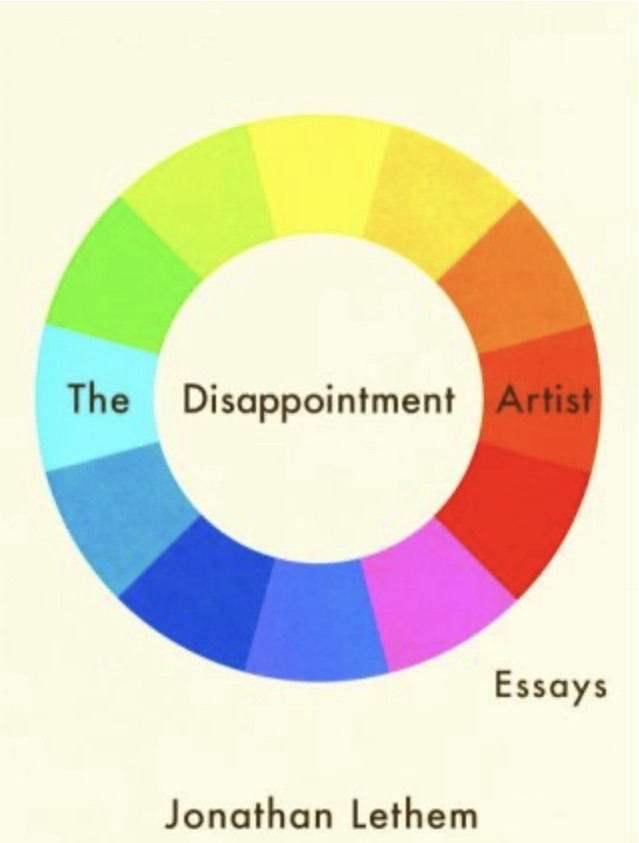
    Jonathan Lethem published his first novel Gun, with Occasional Music in 1994, the year of my birth. This is an irrelevant fact, and yet it holds an appeal for me: that this author has been an active literary force for my whole existence. Of course, timeframe is no indication of appeal, and I had been aware of Lethem ever since finding Motherless Brooklyn on a 100 greatest mysteries and thrillers article on Amazon (it was liberal in its selection, since it also had The Name of the Rose). But I have never felt strongly drawn to his work. The only thing I read by him was the title story from his collection, Lucky Alan, which I recall not being impressed by. Now after reading his first essay collection The Disappointment Artist (2005), I feel compelled to try one of his novels, and I will definitely be putting his other essay collections up on my TBR pile.

    The Disappointment Artist has been criticized by some readers for being self-indulgent. To me, that is the book’s biggest strength that carries it forward. Lethem pitches the book as “a series of covert and not-so-covert autobiographical pieces.” Autobiographies, by nature, are self-indulgent. But as a result, they can be in danger of sliding into narcissism, especially if the readers does not share the author’s enthusiasms or outlook. I personally do not care about Marvel comics, Philip K. Dick, The Searchers, or John Cassavetes. But Lethem made me understand his enthusiasms and why they were his enthusiasms. Eventually, I stopped caring what he was talking about, and just began to enjoy hearing him talk about it. The only other writer who has provoked this reaction in me is Roger Ebert; Lethem now joins his company.

    Lethem’s secret to winning me over was this: he writes with the passion of a fanboy and the mind of a critic. To quote a review on Goodreads, “Lethem is a fan but not a Fan, and a critic but not a Critic.” He has the devotion of a dedicated fanboy, but observes what they might overlook or refuse to acknowledge; both sides balance each each other out.

    This is best shown in the opening essay “Defending The Searchers” (tellingly subtitled, “Scenes in the Life of an Obsession”). In it, Lethem describes his relationship with the aforementioned film, from the disastrous time he screened it at the campus film society in college (having never seen it before), to the argument over it that led him to lose a friend, his encounter with a professor who was writing a piece about the film that he never finished, to finally admitting the ridiculousness of his own obsession:

    “I diminished the film, I think. By overestimating it, then claiming myself as its defender, I invented another, more pretentious way of underestimating it. My wish to control its reception was a wish to control my own guilt and regret, not anything the film need from me or from anyone… But there might not be anything to struggle with, no triumph to claim, nobody to rescue. Wasn’t it possible that John Wayne should’ve left Natalie Wood in the tepee—that she was happier there? Weren’t he and I a couple of asses?”

    The essay succeeds beyond its subject matter (I personally have not seen the film), and becomes about the way all obsessive fandoms treat the flaws and controversial aspects in their beloved work. The essay could be about Trainspotting, Portnoy’s Complaint, Neon Genesis Evangelion; any work of art with a polarizing/problematic reputation. In essence, Lethem reaches the same conclusion as Roger Ebert did writing about The Birth of a Nation: “All serious moviegoers must sooner or later arrive at a point where they see a film for what it is, and not simply for what they feel about it.”

    Lethem’s family is the book’s anchor. The title essay looks at Edward Dahlberg, literature’s biggest misanthrope (he makes William H. Gass look tame by comparison; he also looks exactly like how I thought he would, based on the photo in the link) through the lens of Lethem’s aunt, who had both the misfortune and luck to be in his creative writing class in Kansas City. In “Lives of Bohemians” he gives us look at his father, the painter Richard Brown Lethem (see images below) in form a mini memoir of growing up in Brooklyn in the 70s. But the biggest presence in the book is that of his late mother, Judith Lethem, who died of cancer when he was 14. For a good deal of The Disappointment Artist Judith remains in the background, a key force never quite fully glimpsed, finally leaping forward at the end of the book in absent presence and then receding like the Loch Ness Monster:

    “My mother, because of her verbal flair, and her passion for books, was taken or mistaken by her friends as a writer to be. Pregnant at twenty-one, and a mother of three by the time she, that at 32, began to die, she never had much chance. It is impossible to know whether she would’ve made anything of that chance if she had.”

    “Her gift to me on my fourteenth birthday, the last while she was alive, was a manual typewriter. The summer after her death when I was fifteen, I wrote a 125-page ‘novel’ with the manual typewriter, mostly on torn-out, blue-lined notebook paper. in that same year I typed poems, of a fragment and impulsive sort. Truthfully, then more resembled song lyrics, since I wasn’t a reader of poems then. I recall one which spoke with my mother and the possibility of her writing. ‘You can’t write when you’re sick in bed,’ was its much-repeated chorus… This poem was on one hand sympathetic. I knew, at least consciously, that my mother’s illness was involuntary. so I offered forgiveness: she couldn’t be blamed for not having written. Yet it was also an admonitory poem— really, admonitory to myself.”

    There have been many writers who take up the craft inspired by the success or failure of a family member in that area. In my family, while he was not the reason I took up writing, we had a failed writer of our own: my maternal grandfather, Paul Rusanowsky. A former newspaper man who wrote speeches for the governor of Puerto Rico, worked at the San Juan Star at its height (still unhappy years later that his bit about Kruschev’s shoe got bumped from the front page), produced two lovely daughters in my mother and aunt, but was never able to write the book he dreamed of, about his childhood growing up on a farm in Milford. He did make attempts, and we found some of them after he died.

    Beyond Jonathan Lethem’s critical abilities, passionate but measured enthusiasm, and interesting asides (did you know he grew up with and went to the same high school as Lynn Nottage?), what makes The Disappointment Artist not only great criticism, but poignant, is the fact that like the author, I have a Judith Lethem of my own.

    Patrick Paul Barrett

    Richard Brown Lethem
    “Shanna Wheelock”
    “Mirage”
    Richard Brown Lethem
  • On one level, reviewing and offering critical opinions on various forms of media is a task requiring patience and stamina. Deadlines, slogging through something you despise, trying to find something original to say about a work you have no opinion on, the problems pile up. But unlike a professional critic, I can take or leave something as I please and not worry about the consequences.

    Why do I write criticism? I write for myself to find out what I think of something. I may have a clear opinion in my head, but until I get it down on paper and express it, I will not know what I really think and feel. That and I just enjoy it because it is just one more way of sharing my enthusiasms. I am the child forever coming up to his playmates ready to tell them, “you have to see this!”

    It was the late film critic Roger Ebert who let me see the possibilities of good criticism. His whole body of work has exerted an influence over me for about half of my life, but I must single out one piece of his that has impacted me more than any other thing he wrote. In his 1991 essay, “A Memo to Myself and Certain Other Film Critics” (Which you can read in full under its original title “A Film Critic’s Modest Proposal” through the link at the bottom.), Ebert talked about the “director-oriented approach” he took to reviewing Martin Scorsese’s remake of Cape Fear (1991), and the approach he took to his job as a whole:


                            “Writing daily film criticism is a balancing act between the bottom line and the higher reaches, between the answer to the questions (1) Is this movie worth my money and (2) Does this movie expand or devalue my information about human nature? Critics who write so that everybody can understand everything are actually engaging in a kind of ventriloquism— working as their own dummies. They are pretending to know less than they do. But critics who write for other critics are hardly more honest, since they are sending a message to millions that only hundreds will understand.”


    Concluding the essay, Ebert feels he straddles the line “halfway between what you want to know and what else I want to tell you.” This is the approach I try to take, especially in my manga reviews when I find myself debating whether I should slip in a reference that people might not get, and whether said reference enhances the piece or is just showing off. It is one thing to reference Haruki Murakami when writing for the otaku set, quite another to reference William Gaddis. I also try to estimate the knowledge base of my readers that way I do not waste space retelling details they already know, while also accounting for readers who are not up to speed. It is a balance between not treating your audience like idiots but not going over their heads.

    A different difficulty arises when my feelings about a piece of art clash with the quality of the art itself. It is difficult to review something that one does not have strong feelings about, positive or negative. Even more troublesome are the books, etc., that I admire and appreciate as well crafted and good, but do not personally care for. Reading Jonathan Safran Foer’s Extremely Loud and Incredibly Close in high school provoked this reaction (although I have been meaning to reread it one of these days because it seems to hold up better in my memory). In cases like that it can be difficult to divorce my personal feelings from the merits of the work. A good argument can also be made that I should not do such a thing, since no two readers will ever have the same reaction to a work of art, even if they both thoroughly enjoy it, and that the different temperaments of critics toward their subjects is what makes them unique.

    John Updike discusses some of these struggles in the forward to his essay collection Picked Up Pieces (1975) while laying out his rules for book reviewing. Say what you will about his fiction, his rules are a good reference point for an aspiring critic. They are as follows:

    1. “Try to understand what the author wished to do, and do not blame him for not achieving what he did not attempt.
    2. Give enough direct quotation—at least one extended passage—of the book’s prose so the review’s reader can form his own impression, can get his own taste.
    3. Confirm your description of the book with quotation from the book, if only phrase-long, rather than proceeding by fuzzy précis.
    4. Go easy on plot summary, and do not give away the ending. (…Most ironically, the only readers who approach a book as the author intendeds, unpolluted by pre-knowledge of the plot, are the detested reviewers themselves. And then, years later, the blessed fool who picks the volume at random from a library shelf.)
    5. If the book is judged deficient, cite a successful example along the same lines from the author’s oeuvre or elsewhere. Try to understand the failure. Sure it’s his and not yours?


    All good practical advice, but then, Updike goes the extra mile: (the bolding is me.)


                “To these concrete five might be added a vaguer sixth, having to do with maintaining a chemical purity in the reaction between product and appraiser. Do not accept for review a book you are predisposed to dislike, or committed by friendship to like. Do not imagine yourself a caretaker of any tradition, enforcer of any party standards, a warrior in any ideological battle, a corrections officer of any kind. Never, never… try to put the author ‘in his place’ making of him a pawn in a contest with other reviewers. Review the book, not the reputation. Submit whatever spell, weak or strong, is being cast. Better to praise and share than blame and ban. The communion between reviewer and his public is based upon the presumption of certain possible joys of reading, and all our discrimination should curve toward that end.”


    Although he regards this as a less fully formed rule, Updike undersells himself in that last quote. Of course, he admitted that such things were “easier said than done,” and in today’s climate where liking or promoting the wrong book can be a hand grenade for people with a social media presence, one should be cautious, but not overly cautious. Nonetheless, there are certain books that while I enjoy, I would never write about on this blog, for fear of backlash, deserved or not.

    This is a good transition into the question, “what do I choose to write about?” The answer is anything that provokes a reaction within me. The most trouble I had in high school in college when writing papers for English class was when I had to write about something that I had no strong reaction to, positive or negative.

    Another literary mentor in criticism, George Orwell, bemoaning his profession in his 1946 essay, “Confessions of a Book Reviewer” commented that:


                “[Book reviewing] not only involves praising trash… but constantly inventing reactions toward books about which one has no spontaneous feelings whatever. The reviewer, jaded, though he may be, is professionally interested in books, out of the thousands that appear annually, there are probably fifty or a hundred he would enjoy writing about. If he is a top-notcher in his profession, he may get a hold of ten or twenty of them: more probably he gets a hold of two or three. The rest of his work, is however conscientious he may be in praising or damning, is essence humbug.”


                Continuing to layout the pitfalls of being a book critic, Orwell proposes a solution:


                “The best practice, it has always seemed to me, would be simply to ignore the great majority of books and give very long reviews—1,000 words the bare minimum—to the few that seem to matter. Short notes of a line or two on forthcoming books can be useful, but the usual middle length review of about 600 words is bound to be worthless, even if the reviewer genuinely wants to write it.”


                In the wake of reading Claudia Emerson’s book of poems, Late Wife, which was not bad, but simply did not do much for me, I now have a clearer picture of where Orwell was coming from. I will not be writing a review or commentary on everything I read on this blog, only the ones that I think are worth saying something about, quality aside.


                To close this entry, I want to say a word about what my idea of a successful review is. H.L. Mencken in his early essay “Criticism of Criticism of Criticism” defines his ideal role of a critic in society:


                “It is [the critic’s] business to provoke the reaction between the work of art and the spectator. The spectator, untutored, stands unmoved; he sees the work of art, but it fails to make any intelligible impression on him; if he were spontaneously sensitive to it, there would be no need for criticism. But now comes the critic with his catalysis. He makes the work of art live for the spectator; he makes the spectator live for the work of art. Out of the process comes understanding, appreciation, intelligent enjoyment—and that is precisely what the artist tried to produce.”

    Most critics when they talk about their trade speak in similar terms and phrases, and while I can not say I disagree with them, I would like to add to what Mencken and laid out. For me, the greatest joy in writing a review is being able to find out what I think about [the subject] for myself and then sharing it with the people around me.

    And that’s the size of my view!

    Patrick Paul Barrett

    Further references:

    A Memo to Myself and Certain Other Film Critics

    Confessions of a Book Reviewer

  • It has been suggested to me several times that I start a blog, but I always hesitated, fearing I would not be able to maintain it. But now I have decided to take the plunge and, as you can see, I am up and running. For now, I will be making posts once a week on Sunday, with the goal of four posts a month. When people suggested that I start a blog, they always suggested that I talk about books since that was my specialty, but I will not limit myself to books. Other topics will include anime and manga, movies, the occasional current affairs piece (I don’t tend to look at the news much and would not want to write on a subject that I felt I did not at least have a basic understanding of), and maybe some of my own creative writing.

    The name of my blog was inspired by a poem by the Portuguese poet Fernando Pessoa in the guise of his “heteronym” Alberto Caerio (you can Google this for a full explanation). The poem, quoted below, is section VII from “The Keeper of Sheep,” translated by Richard Zenith:

    “From my village I see as much of the universe as can be seen

    from the earth,

    And so my village is as large as any town,

    For I am the size of what I see

    And not the size of my height…

    In the cities life is smaller

    Than here in my house on top of this hill.

    The big buildings of cities lock up the view,

    They hide the horizon, pulling our gaze far away from the

    open sky.

    They make us small, for they take away all the vastness our

    eyes can see,

    And they make us poor, for our only wealth is seeing.“

    P.S. by all means, please feel free to leave comments and feedback, I welcome them.

    Patrick Paul Barrett