In light of pursuing research for my story, I have decided to take a break this week.
The Size of My View
A variety of commentary from a gay neurodivergent writer-in-training
-
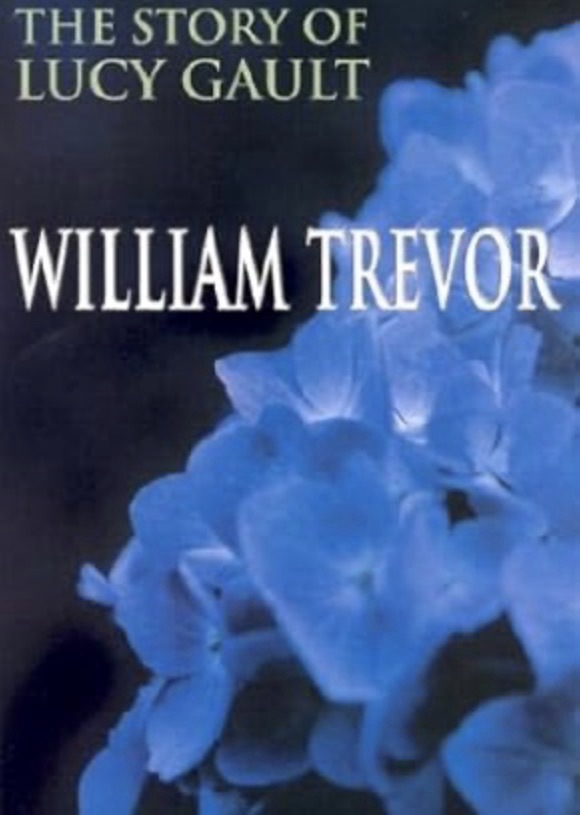
(The Story of Lucy Gault review)
Play this while reading for added effect: it is used in the book in one scene Ordinary life is the hardest thing to depict in fiction of any kind because it is, for the most part, uneventful. We live our lives from day-to-day stuck in the sleep of habit. Of course, great events can happen and impact our world, but even if they do, life goes on as normal most of the time, even if altered. William Trevor’s The Story of Lucy Gault (2002) understands this to a painful degree. In a story that spans the bulk of the 20th century in 228 pages, the characters live through great events, but are largely not affected by them. The novel can be read on a political level, but lacking the knowledge of the social history of Ireland, I chose not to and took the story at face value as both heartbreaking and healing in its ordinariness.
The novel is difficult to review without spoiling it. Of course, I could tell you what happens, but the jacket copy for the book is sparse for a reason. This is the kind of novel that works best without any kind of advance knowledge, you should let it unfold out before you just like life. But I will do a summary of the early pages.
County Cork Ireland 1921: the protestant Anglo-Irish Gault family have had a privileged existence for generations, but after an attempted arson attack on the family estate, Captain Everard Gault decides to move with his English wife Heloise and nine-year-old daughter Lucy to England fearing for their safety. Lucy being nine years old is distraught and cannot bear the thought of leaving, so on the day of the move she decides to make a show of running away to convince her parents to stay, but…
And now I must say nothing more except that the events that transpire will affect the Gaults and the people in their community for their entire lifetimes. I wish I could tell you more, but the joy of the novel is in the unexpected.
Actually, I’m going to stop this review right here. What more can I say when the book speaks for itself? The Story of Lucy Gault is easily among the best books I have read all year.
Patrick Paul Barrett
-
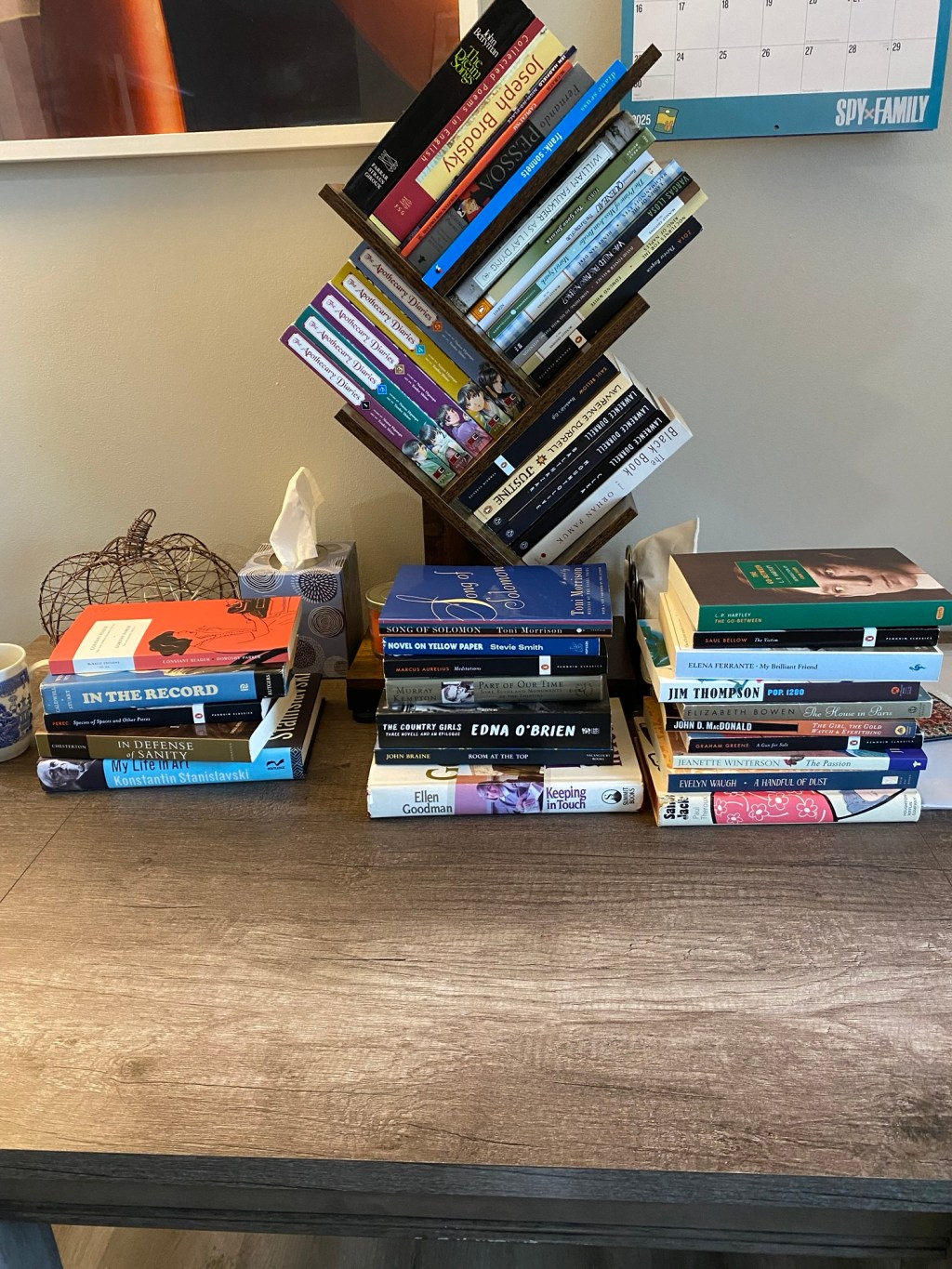
My apartment is in need of a good cleaning as I write this which even by my standards are surprising, considering the extent I cleaned it on Monday. It never takes my apartment long to go to hell again, but this was a new record: Tuesday evening is when the book bomb went off.
My apartment has gotten messy at a quicker rate, but it has not gotten messy like this in a while. I got the crazy idea that I would start rearranging my bookshelves systematically as I had been gradually doing for a while. But this time I wanted a total overhaul, so I began pulling bins out of storage and pulling books out of those bins, and by 7:05 PM on Tuesday, this was how my bedroom looked, to say nothing of the front room:
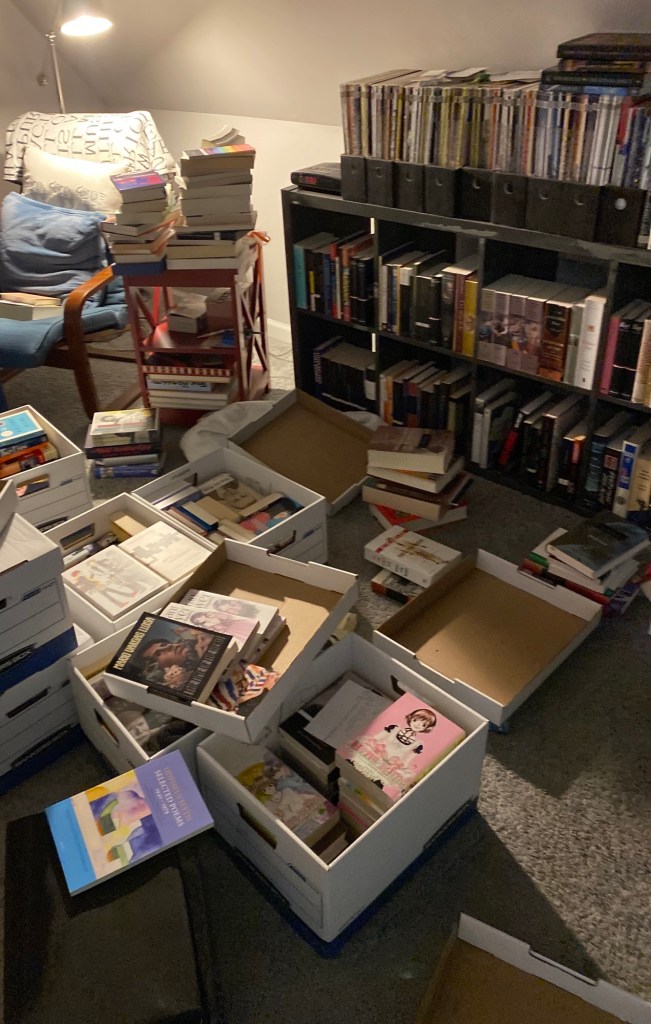
“The horror…
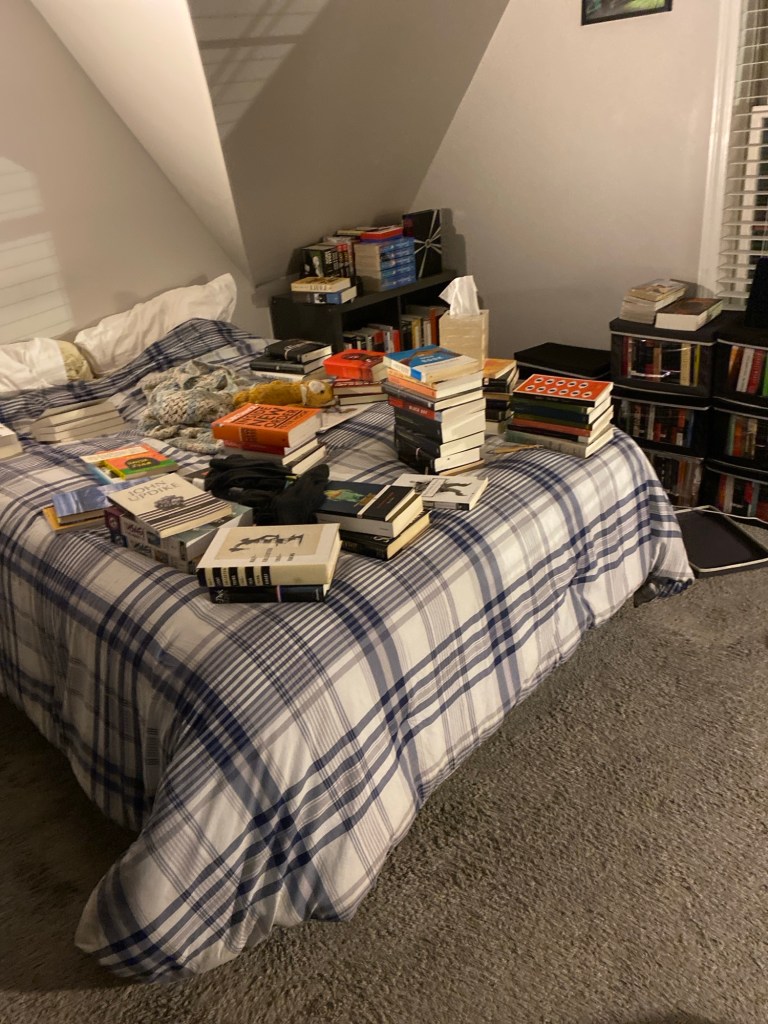
…the horror.” By 9 o’clock, I had gotten a new piling system and moved the books off the bed.
As I’m writing this, I am still in the process of re-organizing my shelves and putting away books and boxes. This is made more difficult by the fact that I am not only selecting books to show off and (possibly) read, I am also going through my collection to find ones to sell or that I am no longer fond of. I am finding this easier than usual, recent events in my life have compelled me to let go of a number of things that I have held onto and no longer need. Grievances, possessions, unhealthy relationships, etc. 
Now comes the interesting trouble of organizing the books I want to keep and display at the moment. Inspired by an article I read, I have been creating categories that are off the beaten path which I display to you in the photos below in various states of competition.

Figure 1 Since this is the first one I finished, it seems fair to show it first. Going across from left to right each level the categories are anthologies, poetry, books in conversation with other books, books featured in Jonathan Yardley‘s Second Reading, Proust, The Paris Review, big fat tomes (any novel over 500 pages), crime/mystery, and short stories. Note: the McGrath, Naipaul and Baldwin books are being used as placeholders on their respective shelves since I ran out of books that would fit in that category.
When I started out, I knew that I wanted to do “typical” sections, but also wanted to jazz it up a bit inspired by an article I read about reading across genre and the idea of having a bookstore with no genres for fiction (scroll to the bottom if you click the link to find the part I’m talking about) and that was the spark that made me want to think outside the box beyond “mere fiction.”

Figure 2 with glimpse of my movie collection Once again I have a poetry section here (I have at least three or four total in the apartment) along with spy fiction section (I normally don’t put multiple books by the same author together, unless they’re part of a series or sequence, with this shelf, I made an exception), assorted non-fiction, and film writings. On smaller shelves getting books and can be tricky if a book is part of a sequence and doesn’t fit because room has run out, which leads to the thing becoming like a puzzle box.
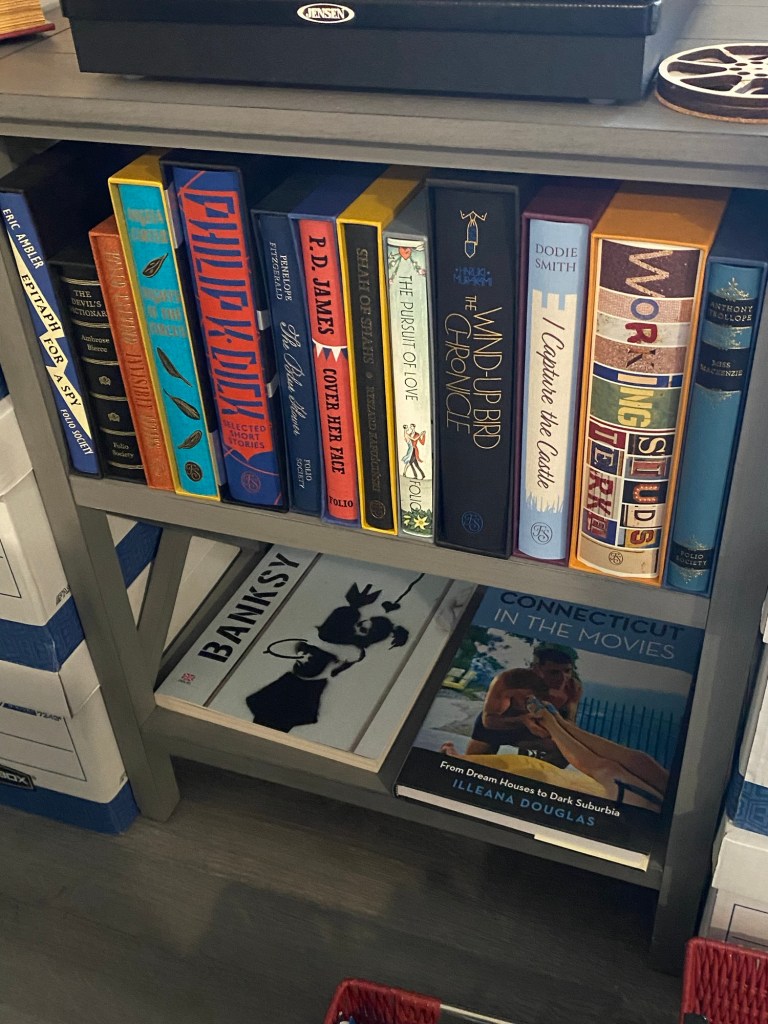
Figure 3 Here we have a selection of Folio Society editions with coffee table books.
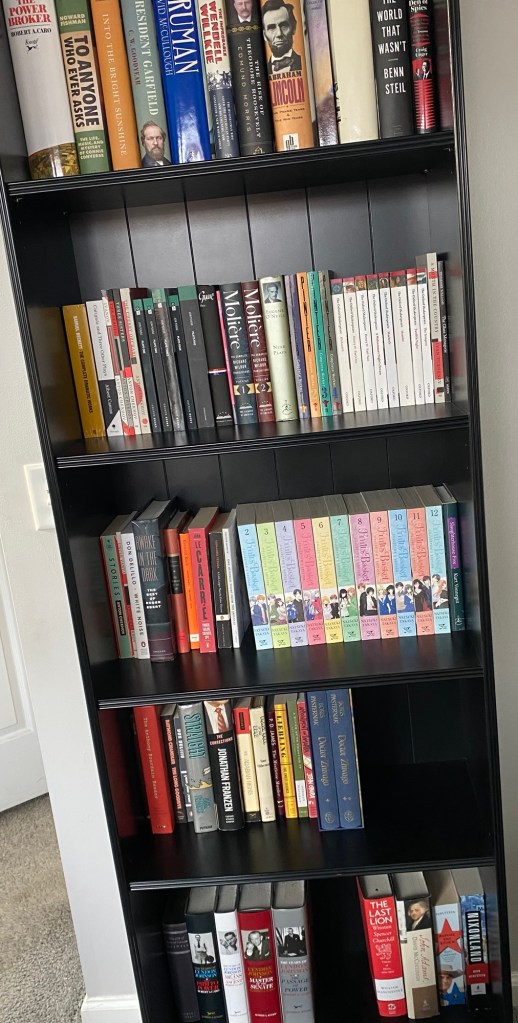
Figure 4 From the top down we have Biography (with the poems of James Schuyler serving as a placeholder), drama, the books of my life (more on this later), short term TBR shelf (for anything I want to read in the coming month), and history/biography, which is still under construction.
To close this post I’d like to draw attention to the books of my life section. it’s a small section because it’s a small category (although ideally I would like a slightly larger shelf to include one or two more). These books transcend liking and loathing and have said something to me in a way that few books have. For those who can’t read the spines, they are The Stories of Anton Chekhov, Uncle Vanya, White Noise, Awake in the Dark: The Best of Roger Ebert, The Remains of the Day, Selected Poems of Kenneth Koch, Tinker Tailor Solider Spy, A Little Larger Than the Entire Universe, One Hundred Poems From the Japanese, Fruits Basket, and Slaughterhouse-Five.
Of course, some of these may be arguable as I did read them sometime ago, and others I have not reread, but they are the ones that stay with me and I intend to talk about them in another post.
Patrick Paul Barrett
-
Dedicated to my cousin Night, for laying the first foundation
About a week ago, I was talking with my 16-year-old cousin Night, and the topic turned into the recurring themes in the fiction she writes. She acknowledged that these themes are often at the heart of many of her favorite books and I quiped that “writers do not have recurring themes, they have obsessions.”
Later, I thought more about her comment, and began to wonder, has anyone ever thought about why they read what they read similar to how writers have obsessions they are drawn to? I don’t mean just in the genres they read (historical, mystery, fantasy, biography etc.) but in the way that their reading preferences reflect their inner psyche; reading as a therapy session.
Being autistic has colored my reading themes a good deal. I find that I am often drawn to “novels of manners“ (see definition here), which is not a surprise given my social anxiety. I am often fascinated by rigid social codes and pecking orders that govern societies and worlds. I think I am less interested in people who rebel against them and more drawn to the conformists who are slowly suffocating as a result of them and unable to express themselves.
One of my favorite novelists, Anthony Trollope, was, in public life, a conservative Tory with a love of traditionalism, but the humanist/novelist side of him constantly reminds him in his fiction that everything that he holds sacred is built on a rotten foundation. It is a conflict I am not sure he was aware of, and it makes reading his novels a fascinating tug-of-war between the values of the Victorian patriarchy and a more liberal humanism.
In Doctor Thorne (1858), the third book in the Chronicles of Barsetshire series, and the novel Trollope considered his favorite, this tug of war is on full display. The novel romanticizes the Tory landed-gentry of England and mourns their decline, contrasting them against the more prejudiced characters who are Whig Liberals, without letting either off the hook. It is a scathing portrait of a society that sees people only in terms of their bank accounts and social class.
Another recurring reading theme is the fear of wasting one’s life. If I look at the small shelf I have in my bedroom devoted to “the books of my life,” there are two books that deal explicitly with this theme: Anton Chekhov’s 1897 play, Uncle Vanya and Nobel Laureate Kazuo Ishiguro’s Booker-prized classic, The Remains of the Day (1989). I have read both several times and last year I saw a production of Uncle Vanya at Lincoln Center with Steve Carell in the title role. Both ask the question, what should we do with our lives? And what do you do when you fear/know you have wasted yours by putting your own needs on hold for someone else? The title character in Vanya has spent much of his life in the service of his brother-in-law, a noted professor, only now to see him as a hack. Stevens the Butler in The Remains of the Day devotes himself to his employment to Lord Darlington, unaware of his boss’ Nazi sympathies, and as result, loses the love of his life.
I have never been in the position of putting my needs on hold, but what I identified with in these works were characters who were trying to find meaning in the wrong places and realized too late what they had done. Even now it is something I still worry about; the fear of wasting my life and letting the chance for something better pass me by. Or even trying and having it all come to nothing.
Patrick Paul Barrett
-

13 Ways of Looking at Roger
(Getting back to writing after my illness and two week break…)
Roger’s style evolved throughout his career, and not just in terms of experience. If you compare one of his early reviews from the late 60s, to the last pieces he wrote before his death, you will find yourself looking at two different critics. In his earlier reviews, Roger used his life to talk about movies. But some point along the way this changed, and by the end, he used movies as a way to talk about life.
To give a sense of his evolution, I have picked 13 reviews from the course of his career showing his development in how he viewed movies and life. When making the selection, I was aware of what would be left out, so I have tried to show off my favorites while also being representative. I have also not included any of his “Great Movies” essays, in an attempt to get a more “immediate” feel.
- Bonnie and Clyde (1967) Like Vertigo and It’s a Wonderful Life, Arthur Penn’s fictionalized account of the legendary depression era outlaws was not an immediate success upon release. The film received only one positive review upon its opening (guess who’s?). Roger would later name it the best film of 1967, his first full year as a film critic. In paralleling the violent lives of the outlaws, with 1960s America, Roger went against the (then) census opinion with his own argument, although he is still stylistically in debt to his mentors (Pauline Kael especially).
- McCabe & Mrs. Miller (1971) Roger ranked McCabe… second on his list of the 10 best movies of 1971 (He would later admit that this was a mistake and that it should have been at the top spot instead of The Last Picture Show). Having seen this film because of Roger’s “Great Movies” essay (which is where I first heard of it), I see that by this time he was starting to come into his own as a critic. Quintessential Roger line from the review: “Death is very final in this western, because the movie is about life. Most Westerns are about killing and getting killed, which means they’re not about life and death at all.” In his look at Robert Altman’s melancholic “anti-western,” Roger illuminates a movie with life where you might not expect to find it.
- The Godfather, Part II (1974) One of Roger’s most controversial judgments that earned him no end of grief from readers (see also Blue Velvet), dating from the era that won him the Pulitzer Prize for Criticism. His main criticism of the film (which he would reinforce even when he elevated it to “Great Movie” status, where he stated he still stood by every word of his first judgement) was that the film’s layout, contrasting Michael’s fall with the flashbacks showing Vito’s rise, structurally weakened the film. Not having seen it, I cannot vouch for that. I chose this review from Roger’s “Pulitzer year” to show a different side of him as well as showing him going against popular opinion. That and it’s also one of his lengthiest and best written reviews from a technical standpoint.
- The Hindenburg (1975) This is one of two “thumbs down” reviews I have picked for this post, this one to show “Bad Roger” at his caustic and hilarious best.
- Hannah and Her Sisters (1986) Choosing this particular review was fraught, given the director is Woody Allen. In the end, I went with it because it shows the development of Roger’s critical style (the entire passage where he talks about the sensibility and viewpoint of the artist as a character is one of the best things he written) as well as hinting at the more “introspective” style he will adopt in later years
- JFK (1991) Another case of Roger going against the grain in a different way and stepping to bat for a film attacked upon its release. His defense of the film hinged upon the idea that the film was about the “feelings” and not the “facts” of the Kennedy assassination (something he gave more elaboration on when he revisited the film for his “Great Movies” series), a position that was later backed up by Oliver Stone who said the film was “not about what did happen, but about what might’ve happened.” (Later named as the best film of 1991)
- Maborosi (1995; stateside release 1997) Now here is one that I would never have heard of had it not been for Roger. Hirokazu Kore-eda’s debut about a Japanese widow trying to come to terms with the suicide of her husband is shot through with the influence of Yasujiro Ozu (a favorite director Roger and I both share). Note Roger’s comment that it is a film “where you actively have to place yourself in the character’s mind,” something most American films would never dare attempt.
- The Truman Show (1998) If I had to pick a single review from Roger’s oeuvre to show off all of his strengths, this would be it. Roger the critic meets Roger the philosopher meets Roger the humanist as he begins to start using movies to talk about life. Two big thumbs up.
- Donnie Darko (2001) The second “thumbs down” review on my list, but I’m going to question Roger’s judgement. Despite giving the film 2 1/2 stars out of four (his highest “bad rating”) he does not seem to dislike the film that much. Putting aside his criticism of the ending, he has more positive things to say than negative. In my opinion, Roger liked this film more than he would like to admit, or was conflicted when he sent his review off to the copy editor. Footnote: Roger gave the director’s cut a half star more, while saying that his opinion was largely unchanged (compare with Godfather Part II above).
- Shopgirl (2005) Dating advice disguised as a movie review: Roger’s look at the adaptation of Steve Martin’s novella has so much good relationship talk, that the film itself seems to be beside the point.
- Synecdoche, New York (2008) First post cancer review: like Shopgirl and The Truman Show only now working on a higher plane of writing and thought quality. The most unusual review of Roger’s that I’ve ever read and a contender for his greatest. 
- The Spectacular Now (2013) I have a specific memory of reading this review. I was on Rotten Tomatoes looking at the critic opinions of new movies that had come out, and under the review reviews for this film I saw a review attributed to Roger. I clicked on it instantly, not because I particularly wanted to see the film he was reviewing, but because I missed hearing his voice, and it was a joy to hear it one more time no matter what he was talking about.
- To the Wonder (2013) The last review Roger ever wrote, so naturally it earned the automatic place on here regardless of what it was. What starts off as a typical movie review morphs into a brief but thoughtful meditation on the movies as a whole:
“Why must a film explain everything? Why must every motivation be spelled out? Aren’t many films fundamentally the same film, with only the specifics changed? Aren’t many of them telling the same story? Seeking perfection, we see what our dreams and hopes might look like. We realize they come as a gift through no power of our own, and if we lose them, isn’t that almost worse than never having had them in the first place?”
I miss you so much Roger. There are not enough thumbs to show how much you mean to me.
Endnote: there was going to be a part three of this, but I’ve decided to shelve that idea. I’m really surprised how well this came out and I think this wraps it up perfectly.
Patrick Paul Barrett
-
Due to an unfortunate illness, I am once again postponing this week’s post.
-
Due to some unforeseen personal complications, I am delaying my next blog post by a week in order to take care of some personal matters.
-

Dedicated to MT, for having the uncompromising courage to be a great friend.
Play while reading Opening Titles
April 4th 2013: I am in a restaurant parking lot, listening to the CD of Abbey Road that I just purchased. Less than 30 seconds into ”I Want You (She’s So Heavy),” my driver, a friend of a friend, turns and looks at me and says, “Patrick, Roger Ebert’s dead.” Around the same time, I received a text telling me it’s time to go into the restaurant for the autism group I’m attending. I don’t remember my reaction, only walking into the restaurant whipping out my phone and typing “Roger Ebert obituary” into my search engine. It was all I could think about all through the group. I told them, of course, but no one else cared.
I had known who Roger Ebert was for many years, mainly because of the wrath that descended on him from the video game community when he pronounced that video games could not be art. (One letter to the editor in GamePro magazine quipped that “Mr. Ebert should put two thumbs up and stick a PlayStation controller between them.”) I cannot remember what my thoughts were in regard to this conflict. I do not think that I had any. But the comments stuck in my mind, and probably contributed to my aversion to Roger and his writings.
The first time I can remember reading a review by Roger Ebert would probably have been around 2008. I found a link to one of his reviews through Netflix (back when they still sent discs in the mail). The review was for the film adaptation of James Patterson’s Kiss the Girls (1997) with Morgan Freeman as Alex Cross. I am not even sure that I read the review in full, I think I skimmed it, but something about it must’ve stuck with me, because about a year later, I found myself taking out the first two volumes of Roger’s “Great Movies” essays (2002 and 2005) from the local library along with his “best of” volume, Awake in the Dark (2005; revised edition 2017). and thus began my education in both Roger and the movies.
In Which The Audience Outranks the Critic
Those books were revelations. I learned about directors and movies that I had never even heard of before. The whole arena of world cinema unfurled itself before me like the red carpet; a world I hadn’t even conceived of before. Without Roger, I would never have heard of Fedrico Fellini, Yasujiro Ozu, Luis Buñuel, or the French New Wave. I would not know that there was another Bergman other than Ingrid. I would not have heard about films like Maborosi, 13 Conversations About One Thing, Eve’s Bayou, and My Dinner with André (without which I would not have gotten a joke at the end of the Amphibia episode “Civil Wart” that probably left a good deal of the audience scratching their heads). The biggest legacy that Roger left me however was teaching me how to look and think critically about all art, not just the movies. I’ve already written about that before in the piece entitled “A Way of Looking,” so this article will be my feelings toward Roger and his work and how it influenced me in other ways.
You may wonder why I always refer to my subject as Roger, never Ebert (well, at least until now). This is a habit I have picked up from his fan base; I’ve seen that those who look favorably on him, tend to call him “Roger” and those more neutral to unfavorable use his last name, with exceptions of course. I suppose this marks me as a member of the Roger Ebert “fan club” which is not necessarily a complementary thing among this generation.
People have taken Roger to task, not only when he put his thumbs down, but also when he praised something that they thought was remarkable in its bad quality. There are also those who feel he did not give something enough credit even though he spoke favorably of it. For one of the greatest examples of this, I commend you to the comments section of his review for James Ivory’s The Remains of the Day (1993) which as you see, received considerable blowback, because he gave it a favorable review with no criticisms, but held off a half star. I was not bothered by this, I was more irritated by readers criticizing him for this, to which I would say, “it may not have spoke to him as deeply as it spoke to you, maybe he was having an off week, etc.” Although I won’t pretend I haven’t been puzzled by some of his judgments myself: he gave Office Space (1999) three out of four, despite not having any complaints in his review. Same for Repo Man (1984). I have also been irritated by his forgetting the occasional detail about a film in a review or essay, such as in his “Great Movies” essay on My Man Godfrey (1936) where he misquotes a key line (read the essay and then see the accompanying clip below). Then there are times where I outright disagreed with his judgment, like with Rushmore (1998), where I was tempted to take a line from Pauline Kael, who had a habit of calling him up and saying “Roger, honey, no, no, no,” and according to him, “explain why I was not only wrong but likely to do harm.” But, as Billy Wilder said, “nobody’s perfect.”
For the moment I referred to, see the 2:47 mark Note: This week‘s post has been taking some time to form itself. As a result, I have split it into two, possibly three parts to give myself time to polish.
Patrick Paul Barrett
-
Note: This is the first of a series of posts that I will do about my life out in the world. That this one happens to be political is chance. I plan on having less of that going forward.
October 3rd, late morning: I was walking back from getting some blood work done at QUEST, and indulged in the recurring bad habit of looking at my phone when there was no reason to. I checked my email to see if any books had come in at the library, only to find the following:
“Fellow Democrats,
As I’m sure you are aware, 2nd district BOA candidate Toni Lombardi was selected by district members to complete the unexpired vacancy on the board in her district. In an unprecedented move last month, BOA republicans voted against seating her, thus denying the people of the second district full representation.
We are asking all DTC members and supporters to attend this meeting and if willing and able speak on behalf of what is right. Come early if you can and gather outside city hall. Wear any type of Democrat clothing you may have. Let’s make a statement!
If you have any questions or concerns, please consult with your district chair.
Monday night Oct 6, 7:30PM City Hall”
And with that the placidity of my day was shattered, or, at least, damaged. I admit that I have distanced myself from both local and national politics in an effort to preserve what little sanity I have left. It was not that I was apathetic; in fact, my attitude stemmed from the exact opposite of apathy. I felt the future was unappealing and felt powerless to help change it for the better. But when something happens on your home turf it tends to feel more real and immediate than if it happens in another state or city. And this was the spur. I decided that I would write a brief statement and read it at the Board of Alderman (BOA) meeting.
But like most writing projects with a deadline, I wrote my statement when I was down to the wire, the day of the meeting in fact. I drafted the piece on my typewriter, making various phone calls to Democratic Town Committee (DTC) members to make sure I had my facts straight about the situation, and that I hit the tone I sought of “controlled outrage.” Aside from the conclusion, the statement practically wrote itself, since I had been going over an outline in my head all weekend long. The rest of the day flew by, and then it was time to leave for the meeting.
I arrived early, around 7 o’clock, while the board was going over a separate matter. I stood out in the foyer and on the front steps of City Hall, giving my greetings to people I knew. I would say hello, wish them well, and then with a rebellious spirit, point to my head and say, “do you know what’s in here? A bomb to blow up smugness.” And finally, the meeting began.
The meeting opened with public comments, with each speaker being allowed three minutes or less to talk. I sat with some people I knew, waiting for my turn. Three other people went before me, two of them commenting on the same issue I planed to speak on. I finally got up and walked to the lectern, feeling transparent and nervous. But to my amazement, my speech went off well, no tripping over words, no rushed speech, and most importantly, no frothing at the mouth.
What follows is a rough transcript of my prepared remarks. I diverged a bit, but stuck to the script for the most part. There is also a video recording of the BOA meeting which I have posted below, my remarks come around the 10 minute 50 second mark:
“It is remarkable to see the new lows certain BOA members have risen to. They have denied the people of the second district full representation by voting against seating Toni Lombardi on the basis that there is a conflict of interest since she is a member of the Board of Ed. Their reasoning has the value of a three dollar bill, since records proved past BOA members have served both the BOA & BOE at the same time for both parties.
There are some people, no matter who they are, who think rules and morals do not apply to them except when it works in their favor. like, say, the kind of people who park their cars in designated residents only spots of apartment buildings. The kind of people who are asked to give to charity and immediately respond, ‘ what do I Get out of it?’
The point is not that Toni Lombardi has a conflict of interest. But that the people of the second district have interests that conflict with certain BOA members!”
My remarks begin at 10:50 in A confession is necessary here: I had an ax to grind with our mayor as I stepped up to that lectern. That line about parking was no accident. In the winter of 2024, I came home one night to find a car with MFD1 for a license plate parked at a residents only spot at my apartment building, while a familiar figure walked off in the direction of the bars. I kick myself to this day for not photographing that car. So when the time came to deliver remarks, I made sure that when I spoke a key sentence I tilted my head in a specific direction to a specific someone. I doubt he caught my drift, but then again with that 9% tax hike he instituted along with a 5% (possibly more, my memory may be remiss) raise to his salary, he cannot be blamed for not remembering all of his vices.
I would’ve hung around, but I was starting to get tired and after hearing one more speaker, I quietly exited. I would’ve stayed, but I had an appointment in the morning and did not want to go to bed late. But I did stop into the café to say hello to the barista on duty, and tell of my exploits.
-
(Farewell to My Alter review)
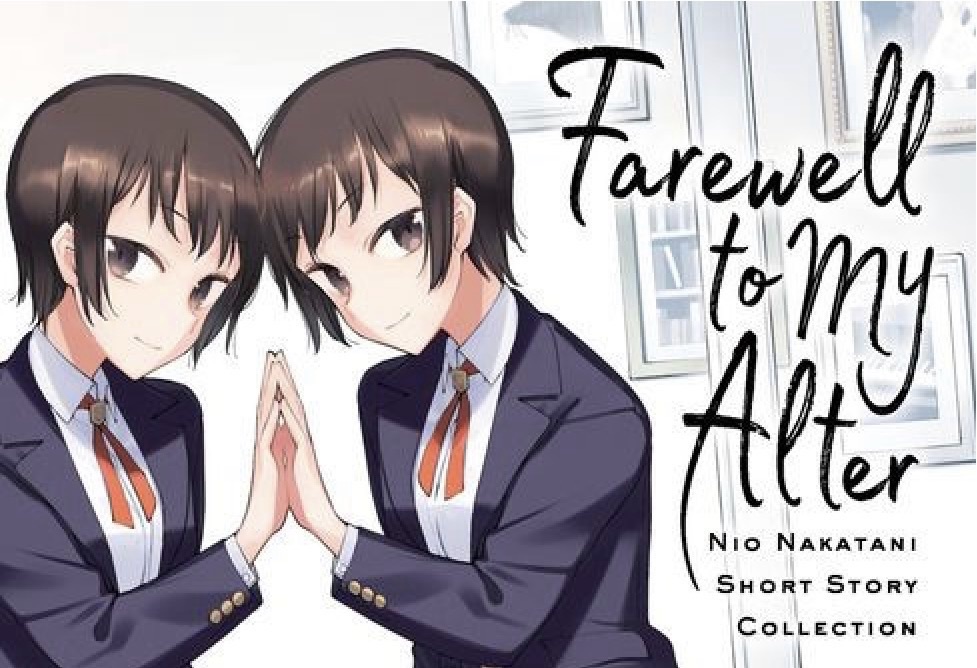
The opening title story of Nio Nakatani’s one-shot collection Farewell to My Alter (2020) sets the bar so high that we wonder if she will keep up that level of quality. She doesn’t. But even if the remaining one-shots do not hit the target dead center, this is still a collection worth reading and owning. All of these one-shots have a more mature and refined feel than most manga out there. It cements Nakatani in the same league as Natsuki Takaya, Mitsuru Adachi and Tatsuya Endo.
What sets Nakatani apart from other manga creators is a sense that she gets her influences and inspiration from places other than anime and manga. In particular, some of the one-shots call up memories of short story master Raymond Carver in how the most powerful emotions go unsaid or unexpressed.
The collection has all Nakatani’s favorite themes: Girl’s Love, identity, and the self. At the center is the title story, which if written as prose, would get recognized as a masterpiece. It opens at the funeral of a high school girl where her twin sister sits in attendance. The mourners speak vaguely of an accident. The reader could be excused for thinking this will be a conventional story about the death of a sibling. It is anything but. It deals not with death, but with life. By starting the story at the end and then jumping back in time, Nakatani gives us a coiled tension so when the final tragedy occurs, we are devastated not because it happened, but because we were powerless to intervene.
The second story, “The Hero Saves the World Three Times” also bears special mention, as Nakatani takes a generic fantasy setting and gives it a Kurt Vonnegut twist. Other stories like “Tear-Flavored Escargot” dip into magical realism and point towards her most recent work, God Bless the Mistaken. “Happiness in the Shape of a Scar” which details the relationship between a High-School girl and her piano-prodigy classmate shows the Carver influence in full force. It moves from placidity to shock and guilt, then circles back without missing a beat, evoking Ian McEwan. There are also cute stories such as “Double Bed” that counteract the more serious ones nicely. The final story, “I Want to Be Kind” rounds out the collection on a melancholic note.
There are some one-shots I liked more than others, but none that are completely awful. Nakatani displays a command of skill that not only compares to the best manga creators, but also the best short story writers. That she could write so many of these stories early in her career before the triumph of Bloom into You is even more astonishing.
Patrick Paul Barrett
Note: The following piece was first drafted back in 2023. Of course I was a different person and writer back then, but going through my files I dug it up and liked it enough to decide to share. The version here has been slightly revised.
 The Size of My View